Inequalities: Flip the Sign or LOSE the Point

Here's a scene I watch play out every single week. A smart Test Taker hits a simple inequality question and solves it in about 40 seconds. They feel great, click an answer and move on. The answer is wrong. The math wasn't hard. One little sign was pointing the wrong way.
When we review it later, the reaction is always the same: "I KNOW that rule." Of course you do. You've known it since middle school. And you still lost the point. THAT is what this post is about.
The rule you already know
An inequality is a math statement that uses a sign like < (less than) or > (greater than) instead of an equals sign. You can add or subtract anything on both sides and the sign stays put. But when you multiply or divide both sides by a NEGATIVE number, the sign has to flip.
Why? Stop and think about it before you read another word. Take 2 < 5. That's true. Now multiply both sides by −1. You get −2 and −5. Which one is bigger? −2 is. So the true statement is now −2 > −5. Multiplying by a negative mirrors both numbers across zero, and the one that was on the left ends up on the right.
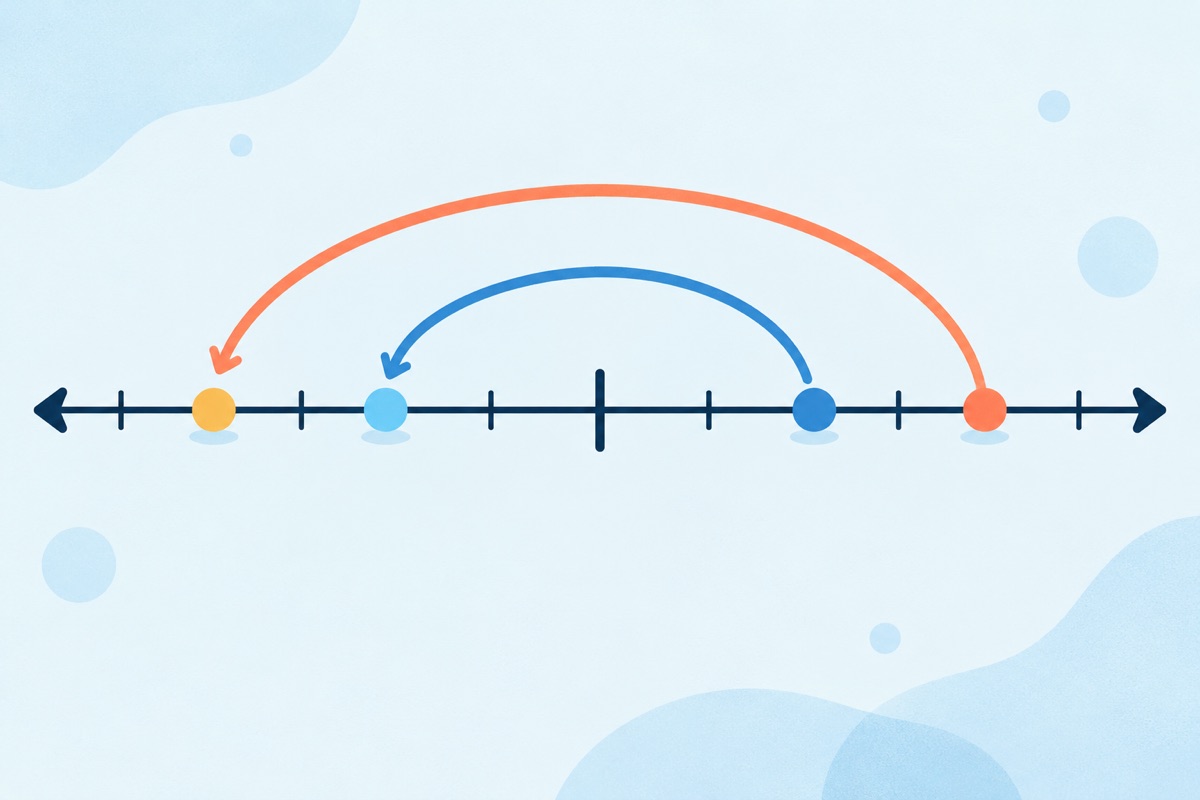
That's the whole rule. Nobody misses it because they don't know it. They miss it because they don't DO it.
Why smart people get burned
The GMAT Quant section gives you 31 questions in 62 minutes. It mixes Problem Solving (regular multiple choice with 5 answers) and Data Sufficiency (a format I'll explain below). That's about 2 minutes per question on average, so most people feel a little rushed. And when people feel rushed, they start doing steps in their head.
The sign flip is the perfect step to skip in your head. It's tiny. It doesn't change any of the numbers. You're busy dividing 12 by −3, you get −4, you feel the win, and the > just rides along unchanged.
Here's the part that should make you uncomfortable. The section is adaptive, which means it picks your next question based on how you did on the last one, and you can't go back to change an answer. Once you click, that point is GONE. There is no "I'll catch it on review."
The people who write this test know exactly where you'll slip. So they put the unflipped answer right there in the choices, waiting for you.
The sneakier version: when you don't know the sign
Dividing by −3 is the easy case. At least you can SEE the negative. The real killer is when you multiply or divide by a variable, like x or c, and you don't know whether it's positive or negative. Now you can't decide to flip or not flip, because you don't know which rule applies. This shows up all the time in Data Sufficiency.
Quick explanation if you're new to it. A Data Sufficiency question gives you a question and two statements. You don't have to find the answer to the question. You decide whether the statements give you ENOUGH information to answer it. The five choices never change:
- (A) Statement 1 alone is enough, but Statement 2 alone is not.
- (B) Statement 2 alone is enough, but Statement 1 alone is not.
- (C) Both together are enough, but neither alone is.
- (D) Each statement alone is enough.
- (E) Even together, they are not enough.
5 mistakes that cost you the point
- Doing the flip in your head. It's one tiny step, so it's the step that gets dropped. INSTEAD: every time you multiply or divide by a negative, write the new inequality as its own line and write FLIP next to it. One second. What do you want MORE: to save that one second, or to keep the point?
- Multiplying or dividing by a variable without asking about its sign. If you don't know it's positive, you don't know which way the sign goes. INSTEAD: before you touch both sides with a variable, ask "do I KNOW this is positive?" If not, test a negative value. The same idea applies to reciprocals (flipping both sides upside down). If both sides are positive, taking reciprocals flips the sign: 2 < 4, but 1/2 > 1/4.
- Never checking. You solved it, so you trust it. INSTEAD: pick one number from your answer and plug it back into the original. If it doesn't work, you caught the error before the test did. That check takes about 10 seconds.
- Thinking the trap only lives in "solve for x" questions. It hides in word problems with phrases like "at least", "no more than" and "fewer than", and in Data Sufficiency. INSTEAD: the moment you see one of those phrases, translate it into a sign on your pad and treat the question as an inequality from the start.
- Calling it 'carelessness' and moving on. 'Careless' is not a diagnosis. It's an excuse to skip the fix. INSTEAD: log every inequality miss as a process error and name the exact step you skipped. I'll bet that if you go through your last practice test, you'll find MORE than one point lost this way.
None of this is about being smarter. The Test Takers who score at the highest levels aren't the ones who never forget a rule. They're the ones who built a paper habit that makes forgetting impossible. The GMAT is a predictable test, and this trap is predictable too. That means you can train it out of yourself.
Your move today
Pull every inequality question you've missed in the last month. Redo each one on paper, writing every step as its own line, with FLIP written wherever you multiply or divide by a negative. Then plug one value back into the original for each. After that, do 5 fresh inequality questions from the official practice materials the exact same way. If you skip the FLIP note even once, start the 5 over. Do it today, not after your next practice test.