Taking the GMAT at Home? Your Kitchen Table Is Now a Test Center

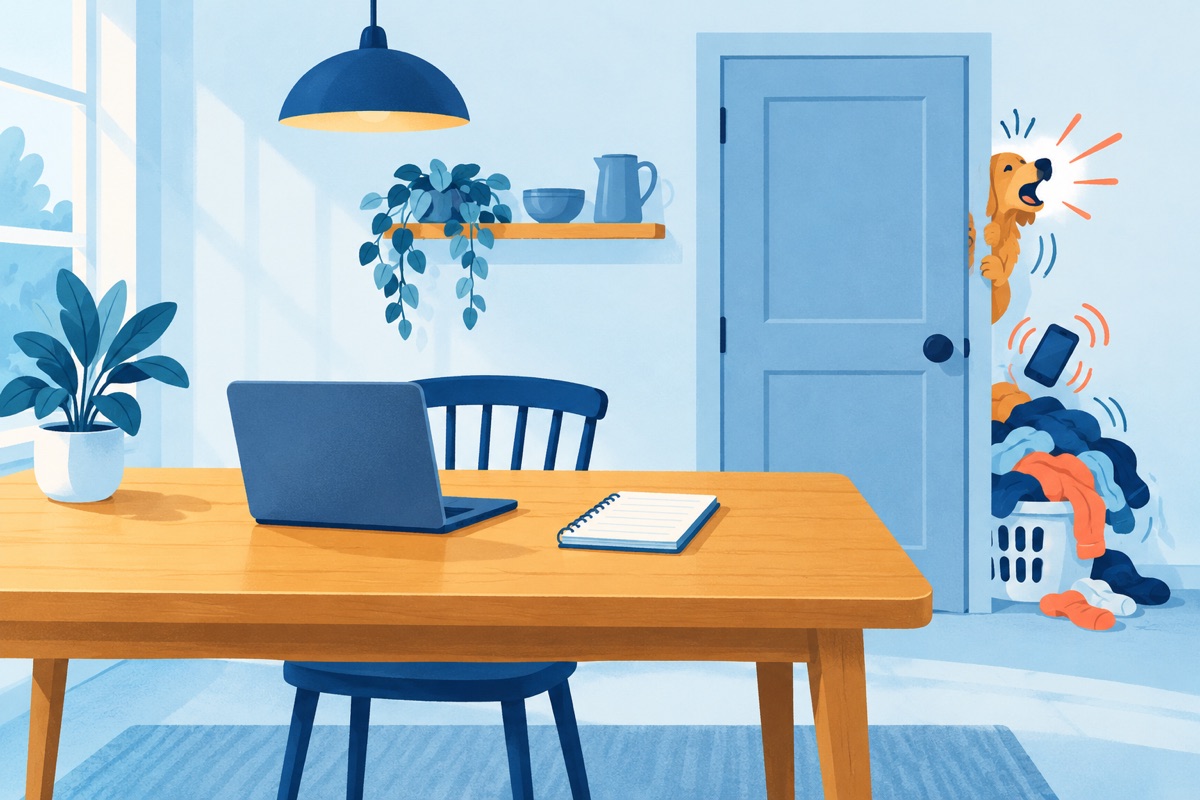
It's 9:00 on a Tuesday morning. Your laptop is on the kitchen table. The dog is staring at you. A delivery truck just pulled up. Somebody in the next room is on a video call, talking louder than anyone needs to. And you're about to start the most important three hours of your MBA application.
Welcome to your new test center.
Since April 2020, GMAC, the group that runs the GMAT, lets you take the exam online from home. For a lot of people that's great news. No commute, no strange room, no waiting in a lobby. But here's my blunt verdict: your house was NEVER built to be a test center. It was built for eating, sleeping, laundry and arguing about the thermostat. If you want it to work as a test center, you have to TRAIN it to be one, and you have to train yourself in it.
The test didn't get easier because you're wearing socks
The exam you take at home is the same GMAT. Here's what you're facing, straight from the official format page:
| Section | Questions | Time |
|---|---|---|
| Analytical Writing | 1 essay | 30 min |
| Integrated Reasoning | 12 | 30 min |
| Quant (Problem Solving and Data Sufficiency) | 31 | 62 min |
| Verbal (Sentence Correction, Critical Reasoning, Reading Comprehension) | 36 | 65 min |
That's about 3 hours and 7 minutes of testing, plus two optional 8-minute breaks. You pick one of three section orders. Your 200 to 800 score comes from Quant and Verbal. And the test is adaptive, which means it picks each next question based on how you did on the last one. You can't go back and change an answer. Every question gets one shot.
So the stakes are identical. The only thing that changed is the room. And the room is the part most people don't train for.
Do the math on a distraction
Stop for a second. How many times did you look at your phone during your last practice set? Be honest. I'll bet the number is BIGGER than you think.
Now say a noise, a buzz or a knock pulls you off the screen for just 10 seconds per question. Quant plus Verbal is 31 + 36 = 67 questions. That's 67 × 10 = 670 seconds. That's 11 minutes and 10 seconds of your scoring sections spent on something that isn't the test. Would 11 extra minutes help you on Verbal? Of course it would.
And those 10 seconds aren't the real cost. The real cost is the re-reading. You lose your place, so you read the prompt again. You lose your train of thought, so you redo the math. Distraction isn't a small leak. It's the cause behind half the 'pacing problems' people bring to me.
6 mistakes I watch people make with the at-home GMAT
- Studying on the couch, testing at the table. Your brain links focus to a place. If every hour of practice happened slumped on the sofa, the table will feel foreign on Test Day.
INSTEAD: Pick the EXACT spot you'll test in, right now. Same chair, same table, same lighting. Every practice test happens there. - Taking practice tests in pieces. Quant on Monday, Verbal on Thursday, skip the essay because it's boring. That's training for a marathon by running sprints.
INSTEAD: Take full-length CATs (computer adaptive tests, the full practice exams that act like the real thing) in the section order you plan to pick, at the time of day you plan to test. Time your breaks at 8 minutes. Not 9. Not 'until I finish my sandwich.' Use the official practice materials for at least some of them, and remember: a CAT measures you, it doesn't train you. One a week is plenty. - Letting the house make the rules. Notifications, family, pets, roommates. If you don't control them, they control you.
INSTEAD: Make a 'test block' deal with everyone you live with. Tell them the start time and the end time. Phone goes in another room, not face down next to you. Do every practice test under those exact rules so Test Day is just one more rerun. - Dropping your notes because the setup feels different. New room, new tools, so people start doing work 'in their heads.' That's pride, and it costs points.
INSTEAD: Read GMAC's rules for the online exam, find out exactly what note-taking tool you're allowed, and practice with THAT tool. Your notes are what save you when the doorbell rings mid-question. You glance down and you're right back where you were. - Cramming the night before because 'it's just at home.' Being home makes it feel casual. It isn't.
INSTEAD: Treat the last week like any other Test Day. Taper, don't cram. Set up the room the night before and walk away. - Treating the home test as a 'practice run.' 'If it goes badly, I'll just take it again.' That attitude shows up in your effort, and the GMAT gives you the score you EARN.
INSTEAD: Go in to get the score you need on the first try. If you end up wondering whether you need to retake the GMAT, let that be a decision about the data, not a plan you made in advance.
Focus is a skill. Train it on real questions.
Here's a Problem Solving question (regular math with five answer choices) to do right now, at the spot you'll test. Phone in another room. Notes on paper. Time yourself.
Notice what saved you in that question. Not genius. A note that said what the question wanted. That's the habit that protects you when the house gets loud.

Your home, your responsibility
At a test center, someone else controls the room. At home, YOU do. That's a gift if you use it and a disaster if you don't. Nobody is going to silence the neighbor's leaf blower for you. But you can pick the quietest time of day, the quietest corner, and you can make sure that by the time you sit down for real, you've done three hours of focused work in that exact chair more than once.
And keep the big picture in mind. You're doing this because the score opens doors. That's the whole point of going after a school that requires GMAT scores. Don't let a dishwasher cycle stand between you and that.
Your challenge for today
Go to the exact spot you'll test. Put your phone in another room. Set a timer for 30 minutes and do a timed set of Quant questions with full notes. Keep a tally mark on the corner of your paper every time your attention leaves the screen, for ANY reason. When the timer ends, count the marks and write down what caused each one.
That list is your first real training plan for Test Day. Fix the top item before tomorrow's session. Then do it again.