Reading Comp: Answer From the Passage, NOT From What You Know
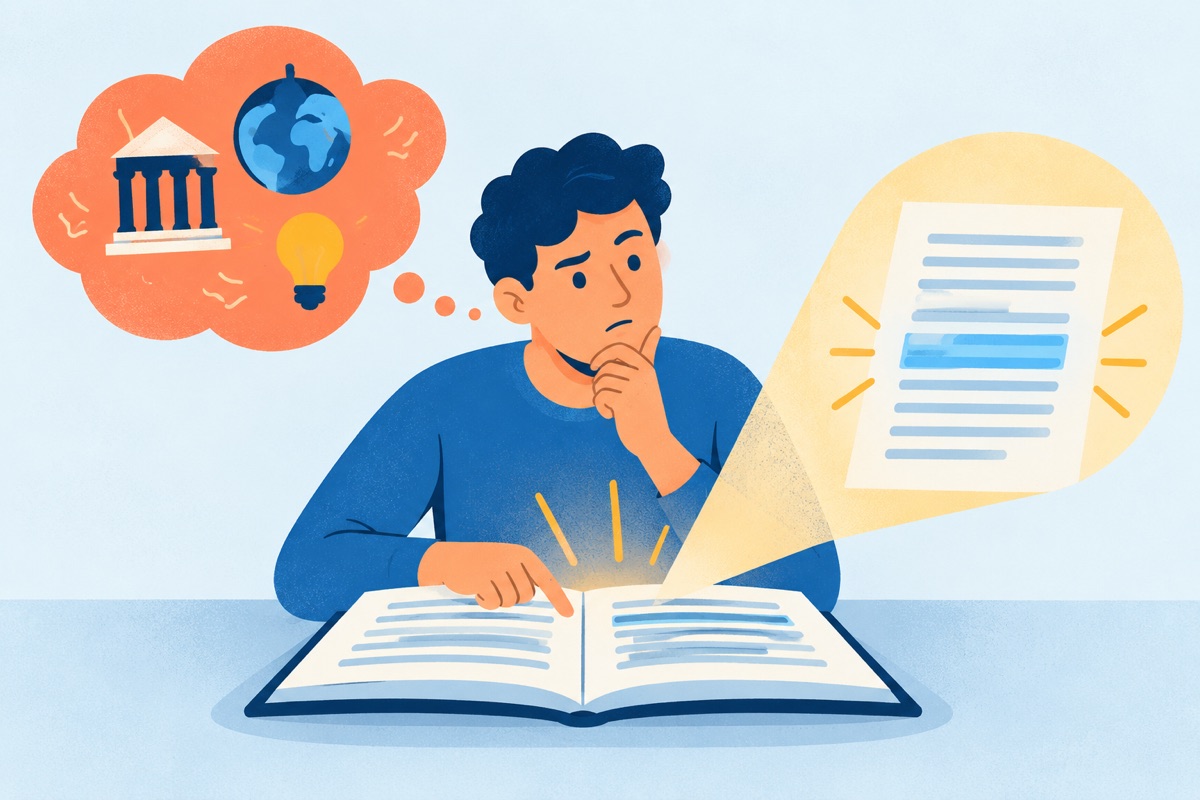
Say you spent five years in banking. You hit a Reading Comp passage about interest rates and think: finally, home turf. You read fast, because you KNOW this stuff. You see an answer that says exactly what you would tell a client, and you click it with total confidence.
Wrong.
I watch this happen every week. The engineer misses the science passage. The marketer misses the passage about brand loyalty. The history buff misses the passage about old trade routes. The passage was not hard. They answered a question the passage never asked, using facts the passage never gave them.
Here is the blunt version. On Reading Comp, what you know is NOT an asset. It is a risk you have to manage.
The passage is the whole universe
Quick setup. Reading Comprehension (RC) is the question type where you read a passage of a few paragraphs and then answer questions about it. On the GMAT Focus Edition, RC shares the Verbal Reasoning section with Critical Reasoning (short arguments you have to judge). That section gives you 23 questions in 45 minutes. Sentence Correction is gone, so reading carries more of Verbal than it used to. That is why your reading has to get sharper.
Every right answer on RC has one job. The passage has to back it up. Not the news. Not your coworkers. Not what is "obviously true." If the passage does not support it, it is wrong, even if it is true in real life.
Stop reading for a second and ask yourself WHY the test is built this way. Do not move on until you have a reason.
Here is mine. The GMAT is measuring whether you can read what is actually on the page. That is the skill you need for a case, a contract or a pitch deck. A test that rewarded outside knowledge would be a trivia contest, and it would be unfair to anyone who never worked in that field. So the writers do the opposite. They build wrong answers OUT of things that sound true, because they know some people will grab them.
Three ways your knowledge gets used against you
- True in the world, missing from the page. The answer states something real. The passage never says it.
- The right idea, the wrong person. Many passages hold two or three views. An answer can match one of them and still be pinned on the wrong group.
- The passage, pushed too far. The passage says "may" or "some." The answer says "always" or "most." Your knowledge fills the gap, so the stronger claim feels fine.

Let's see all three in action.
Notice what won that question. Not knowing about remote work. Pointing at a sentence. That is the whole skill, and it is the same reason the right answer on inference questions is boring.
The mistakes I see, and what to do INSTEAD
Speeding through passages on topics you know. You skim because it feels familiar, and your brain fills in the parts you skipped with what you THINK the author said.
INSTEAD: Read home turf passages a little slower, not faster. Take notes on what THIS author says, especially where it differs from what you expected. Those differences are where the questions live.
Judging answers as true or false about the world. "Is this true?" is the wrong question. Plenty of true things are wrong answers.
INSTEAD: Ask "where's the line?" for every answer you keep. If you cannot point to a sentence, it goes.
Losing track of who said what. Two or three views in one passage, and the answers mix them up on purpose.
INSTEAD: Label every view in your notes with who holds it. Same rule in Critical Reasoning: the argument on the screen is the only argument. That is why the way to evaluate an argument is to find the question that would settle THAT argument, not the one you would argue about at dinner.
Filling gaps with "everyone knows." The passage hedges and you quietly remove the hedge.
INSTEAD: Treat words like "may," "some," "often" and "rarely" as load bearing. If an answer is stronger than the passage, it is out.
Some of you are thinking, "but I really DO know this subject." Great. You have to decide what you want MORE though: to be right about the subject, or to be right on the GMAT. On Test Day, you only get credit for one of those.
Your challenge for today
Pull up the last three RC passages you did. Use official practice material if you have it. For every answer you picked, right OR wrong, write down the exact sentence that supports it. If you cannot find one, write "ME" next to that question, because the support came from you, not the passage.
I'll bet you find at least one "ME" on a question you got RIGHT. That means you got lucky, and luck does not show up on command. Count your "ME" marks today. Then make that number zero.