The 10-Minute Break: PLAN It, Don't Just Take It

Picture minute 6 of your break. You're standing in a hallway, staring at a wall, replaying the Quant question you guessed on 40 minutes ago. Your heart is still pounding. You haven't had any water. Then you look at the clock, realize you have 4 minutes left, rush back to your seat and start your final section already rattled. That break didn't rescue anything. It just ran out the clock.
I watch people treat the GMAT break like a recess bell every single week. It isn't. It's the ONLY tool on Test Day that changes how fresh you are going into a section, and you get exactly one. You can spend it or you can waste it. Both take 10 minutes.
What you're working with
The GMAT Focus Edition runs 2 hours 15 minutes across three sections of 45 minutes each. Quantitative Reasoning is 21 Problem Solving questions. Verbal Reasoning is 23 questions of Critical Reasoning and Reading Comprehension. Data Insights is 20 questions where you read tables, graphs and short sources and decide what the data does and doesn't tell you; it mixes Data Sufficiency, Table Analysis, Graphics Interpretation, Two-Part Analysis and Multi-Source Reasoning. You pick the order of the three sections. You also get one optional 10-minute break. That's the whole menu, and GMAC lays it out on its exam format page.
Three sections in a row means two gaps between them. Your break lives in one of those gaps: after your first section or after your second. So the real question isn't "should I take a break?" It's "which section do I want to PROTECT?"

Forced choice: protect the middle or protect the end?
Take the break after section 1, and you walk into section 2 fresh, then face section 3 with no reset at all. Take it after section 2, and you grind through 90 straight minutes, then get a reset right before your last section.
Most people default to "later" because the end is when they feel tired. That's a decent instinct. It's also a GUESS. You're a future MBA. You don't get to guess when you have data sitting right in front of you.
Here's the rule: put the break right before the section that falls apart when you're tired. Which section that is depends on the order you chose. If you built your section order around your strengths, then you already know which section is your shakiest. Now you need to know WHERE in the test it cracks.
I'll bet the last section of your practice tests is weaker than you think. And I'll bet the damage isn't spread evenly. It piles up in the last handful of questions, where you slow down, re-read and start guessing. Stop reading for a second and think about your last practice test. Do you actually know your time per question at the end of the final section? If the answer is "no idea," that's your first problem.
Here's how to read that kind of data, written as a real GMAT Quant question.
Look at what that example is really telling you. The section average was a perfectly normal 2 minutes. But the test taker went from 1.8 minutes per question at the start to 2.5 at the end. The average HID the collapse. That's what fatigue looks like on paper, and it's exactly what your break is supposed to fix. If your last section shows that kind of slide, your break belongs right in front of it. If your middle section shows it instead, move the break earlier.
Should you skip it?
"Optional" is GMAC's word, not mine. You have to decide what you want MORE: to leave the building 10 minutes sooner, or to walk into a section with a clear head. I've never once heard someone say their score went up because they got home early. Unless your practice data says you perform BETTER when you push straight through, take the break.
5 mistakes people make with their 10 minutes
Replaying the section you just finished. It's done. You can't go back into it. Every minute spent thinking about that probability question is a minute your next section loses. This includes fretting over which answers you changed. You get to review and change up to 3 answers per section, but that happens INSIDE the section, and it's a safety net, not a strategy.
INSTEAD: Say one sentence to yourself, something like "that section is closed," and move on to your routine.
Trying to study. Ten minutes of cramming formulas won't teach you anything new. It will just make you anxious about what you might forget.
INSTEAD: Use the time on your body. Stand up, walk, stretch your back and shoulders, unclench your jaw.
Figuring out food and water on the spot. Deciding what to eat while the timer runs is a waste of the timer. So is discovering you have nothing with you.
INSTEAD: Check the rules for your test center or online setup before Test Day, then pick ONE snack and your water ahead of time. Test that snack during practice so you know it doesn't make you sluggish.
Drifting, then sprinting back. Ten minutes feels long right up until it's gone. Wander around for 8 of them and you'll start the next section flustered.
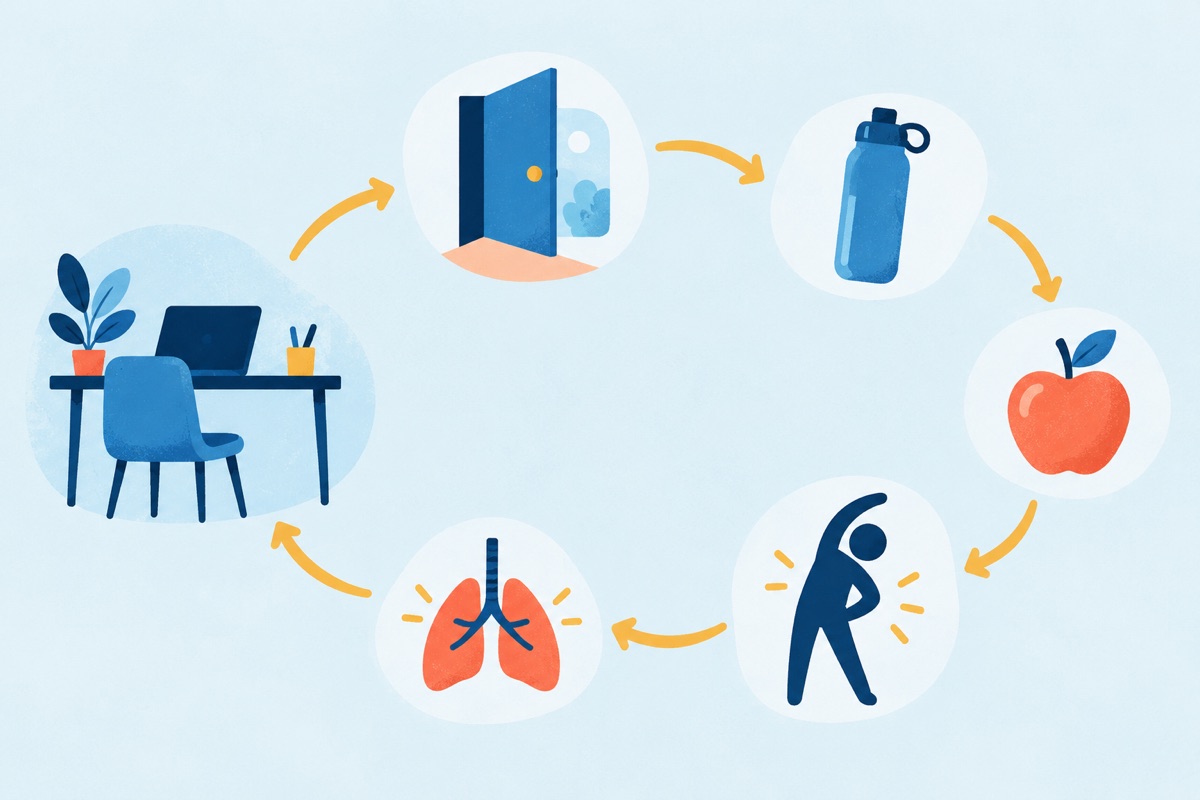
INSTEAD: Run a fixed order every time: bathroom, water, snack, stretch, then 60 seconds of slow breathing. Be back and settled with time to spare.
Walking in with no plan for the next section. The first few questions set your rhythm. Starting cold means you warm up on questions that count.
INSTEAD: In the last minute, give yourself one line of instructions for what's coming. "Notes on every question. Test the answers. No work in my head." That's it.
Rehearse it like it counts
A break routine you've never practiced is just a hope. And Test Day is a terrible day to try something for the first time.
A full-length practice test is a measuring device. It doesn't make you better on its own, so one a week at most is plenty. But EVERY one you take should be a dress rehearsal of the full event, and that includes the break. Same section order you plan to use. Break in the same gap. A real 10-minute timer. The exact routine, snack included. If you can't decide between the two gaps, run one practice test with the break after section 1 and the next with it after section 2. Then compare your time per question at the END of each section, the same way you did in the example. The data will pick for you.
When your break is rehearsed, it stops being a pause and becomes part of the plan. You stop thinking about it, and you spend that energy on the questions instead.
Your move today
Pull up your last two full-length practice tests. For each section, write down your average time per question on the last 6 questions and how many of those you got right. Find the section where both numbers get worse. That's the section your break protects, so put the break right before it. Then grab an index card and write your 5-step routine on it, in order. Your next practice test runs that card, start to finish, on a real timer.