Reading Comp: The Main Idea Is the ONE Thing You Must Know Before the Questions
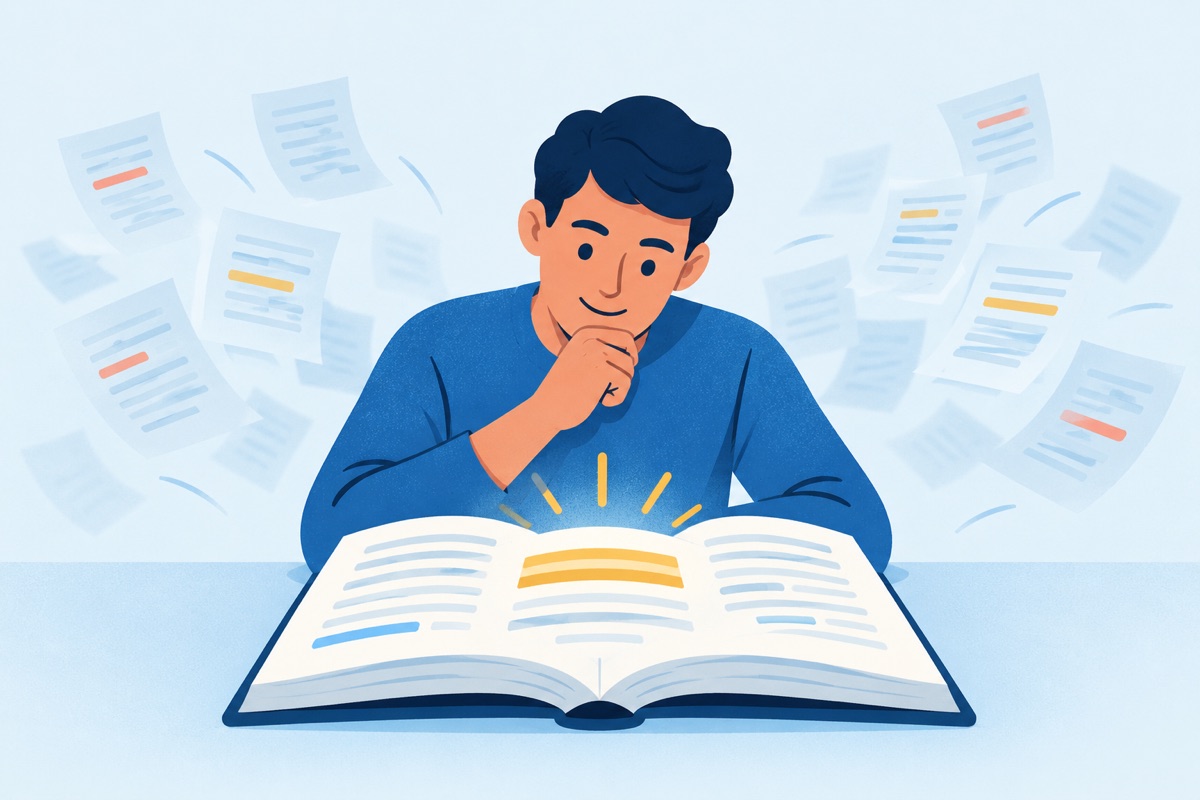
Here is a mistake I watch people make every single week. A Test Taker opens a Reading Comp passage and reads it like there will be a pop quiz on every word. They slow down on every date, every name, every little example. They read the second paragraph twice to be safe. Then the first question asks, What is the primary purpose of the passage? And they freeze. They know a dozen facts and they have NO idea what the author was actually trying to do.
That is not a reading problem. That is a training problem, and it is fixable.
What you are actually being tested on
Reading Comprehension (RC) is one of the three question types in the GMAT Verbal section. You get a passage, then a few questions about it, one at a time. Per GMAC's description of the exam, Verbal gives you 36 questions in 65 minutes, mixed across Sentence Correction, Critical Reasoning and RC. The test is adaptive, which means it picks each next question based on how you have been doing, and you cannot go back to change an answer.
Do the math on that. 65 minutes is 3,900 seconds. Divide by 36 questions and you get about 108 seconds per question, a little under 2 minutes. That is an AVERAGE, not a rule. But it tells you something important: you do not have time to memorize a passage, and you do not need to.
Why not? Because the passage stays right there on the screen while you answer. The details are not going anywhere. The ONE thing that is not written down for you is the main idea: what the author is doing and why. That lives only in your head, or better, on your notepad. So that is what you lock in first.

Main idea first, details on demand
The main idea is the author's big point, the reason the passage exists. Most passages follow a simple shape: here is a view, here is a problem with it, here is what follows. If you can say that shape in one sentence, you can answer most of the questions. For the rest, you go back and look.
Stop reading for a second and think about your last practice set. When you missed an RC question, was it because you could not understand the passage? Or because you answered a detail question from memory and your memory was a little off? I'll bet it was the SECOND one more often than you think. Go check.
Here is the process the strongest Test Takers use:
- Read each paragraph once, at a normal pace.
- After each paragraph, write ONE short line on your pad: what is this paragraph's job?
- After the last paragraph, write the main idea in one line.
- Then, and only then, look at the question.
That set of short lines is your map. It tells you where things live, so when a question asks about a detail, you know exactly which paragraph to go back to.
The mistakes, and what to do INSTEAD
Reading to memorize every detail. You burn time and you still do not know the point.
INSTEAD: Read each paragraph for its JOB. One short line per paragraph, one line for the main idea.
Re-reading the whole passage for every question. This is a huge hidden time cost, and it is a classic cause of what people call a 'pacing problem'. If that sounds like you, read up on defining your pacing problem, because slow RC is usually a symptom, not the disease.
INSTEAD: Use your map to go to the ONE paragraph that holds the answer. Read that part carefully. Leave the rest alone.
Answering detail questions from memory. You remember the gist, you pick the answer that feels right, and you are wrong by one word.
INSTEAD: For every detail question, put your finger on the exact sentence that supports your answer. If you cannot point to it, you have not earned the answer yet.
Falling for answers that copy the passage's words. The question writers KNOW you remember certain phrases. They use them in wrong answers on purpose.
INSTEAD: Match the MEANING, not the words. Ask: does the passage actually say this, in this way, for this reason?
Skipping the notes because "I'll remember it." That is pride talking. You will not remember it as well as you think, especially deep into a long exam.
INSTEAD: Write the map every time, in practice and on Test Day. It takes seconds and it saves minutes.
When to go back, and when not to
Here is the simple rule. If the question asks about the passage as a whole (the primary purpose, the main idea, the author's attitude, how the passage is organized), answer from your map. You already did the work.
If the question asks about something specific (according to the passage, the author mentions X in order to, which of these is stated), go back. Every time. The passage is on the screen for a reason.
So what do you want MORE: the comfortable feeling that you 'know' the passage, or the right answers? You cannot fully have both in the time you get. Pick the right answers.
Your challenge for today
Grab one RC passage from the official practice materials. Before you look at a single question, write one line per paragraph and one line for the main idea. Then answer every question. For each detail question, write down which paragraph you went back to and the exact phrase that proves your answer. If you cannot point to the phrase, mark that question, even if you got it right. Then look at your marks. That list is exactly where your RC points have been leaking, and now you know how to plug it.