Coordinate Geometry: Slope Is Just Rise Over Run (So Stop Panicking)

Here is a scene I watch play out every single week. A Test Taker is cruising through a Quant practice set, feeling good, and then a question opens with the words "In the xy-plane..." You can almost hear the brain shut off. The pencil stops. The eyes go back to the top of the prompt. Then they read it again. And again.
My verdict: that panic is costing you points you should be getting for free. Coordinate geometry is one of the most PREDICTABLE topics on the GMAT Quant section. Most of these questions are built from the same two or three ideas, over and over. The question writers dress them up so they look scary. You are going to learn to see through the costume.
The whole topic fits on an index card
Coordinate geometry is just math on a grid. The grid has a flat line (the x-axis) and an up-and-down line (the y-axis). Every point gets a pair of numbers, like (3, 2): go 3 to the right, then 2 up.
Now here is nearly everything you need for most of these questions:
- Slope is how steep a line is. It is rise over run: how far the line goes UP divided by how far it goes RIGHT. Take two points, subtract the y values, subtract the x values in the same order, and divide.
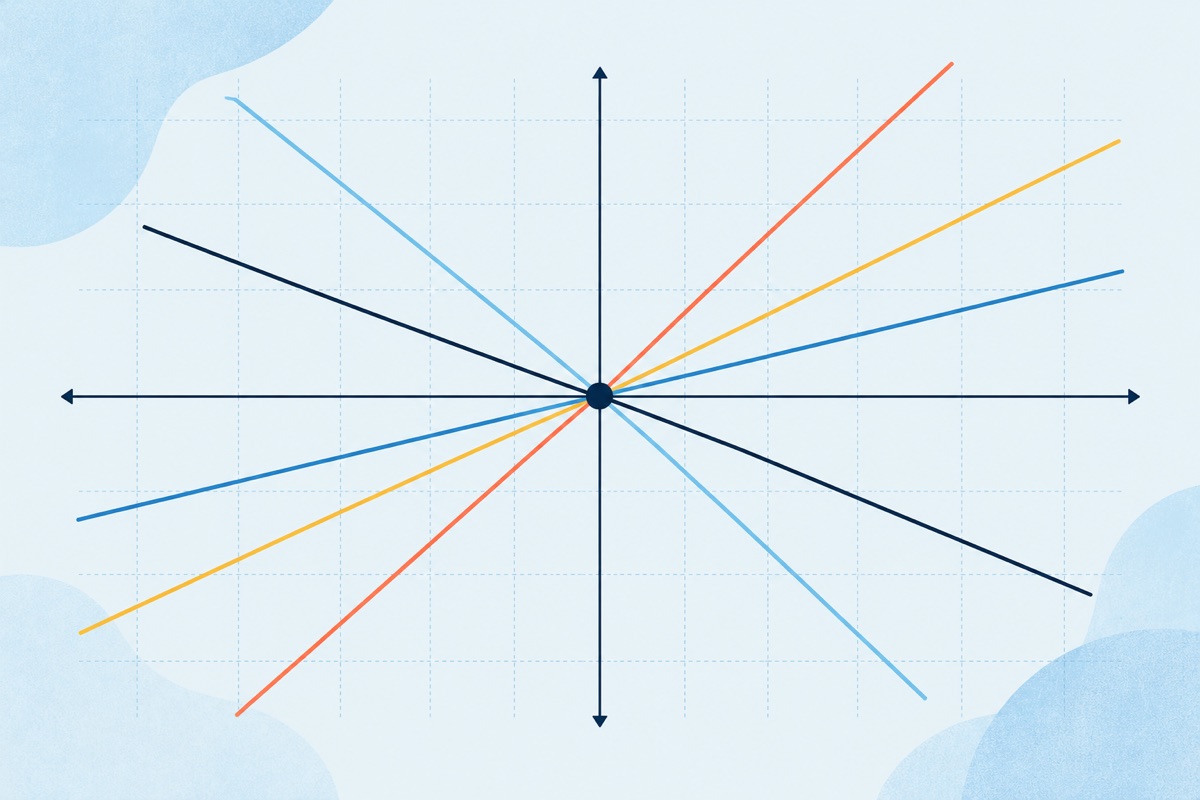
- Positive slope means the line climbs as you move right. Negative slope means it falls. A flat line has a slope of zero. A straight up-and-down line has no slope at all (we call it undefined).
- The x-intercept is where the line crosses the x-axis. At that spot, y is 0.
- The y-intercept is where the line crosses the y-axis. At that spot, x is 0.
- The equation y = mx + b is just a label for a line: m is the slope and b is the y-intercept.
That's it. That is the card. Perpendicular lines (lines that cross at a perfect corner) have slopes that multiply to −1, and parallel lines have the same slope, so add those two notes to the bottom of the card if you want. But I'll bet that the large majority of the coordinate questions you have missed came down to the five bullets above, and you missed them because you didn't draw anything.
Draw the picture. EVERY time.
Stop reading for a moment and think about the last coordinate question you got wrong. Did you sketch the grid on your scratch paper? Be honest. If the answer is no, you already know the first fix.
A rough sketch takes about ten seconds. It does three jobs at once. It shows you whether the slope should be positive or negative. It shows you roughly where the line hits each axis. And it lets you check your algebra against your eyes. If your math says the x-intercept is 6 and your drawing shows the line crossing way over on the left side, something went wrong, and you caught it BEFORE you clicked an answer.
Remember that on this version of the test you get 31 Quant questions in 62 minutes, the test adapts question by question, and there is no going back to change an answer once you move on (you can see the full layout on the official GMAT format page). You do not get a second look. So the check has to happen on your paper, while you are still on the question.
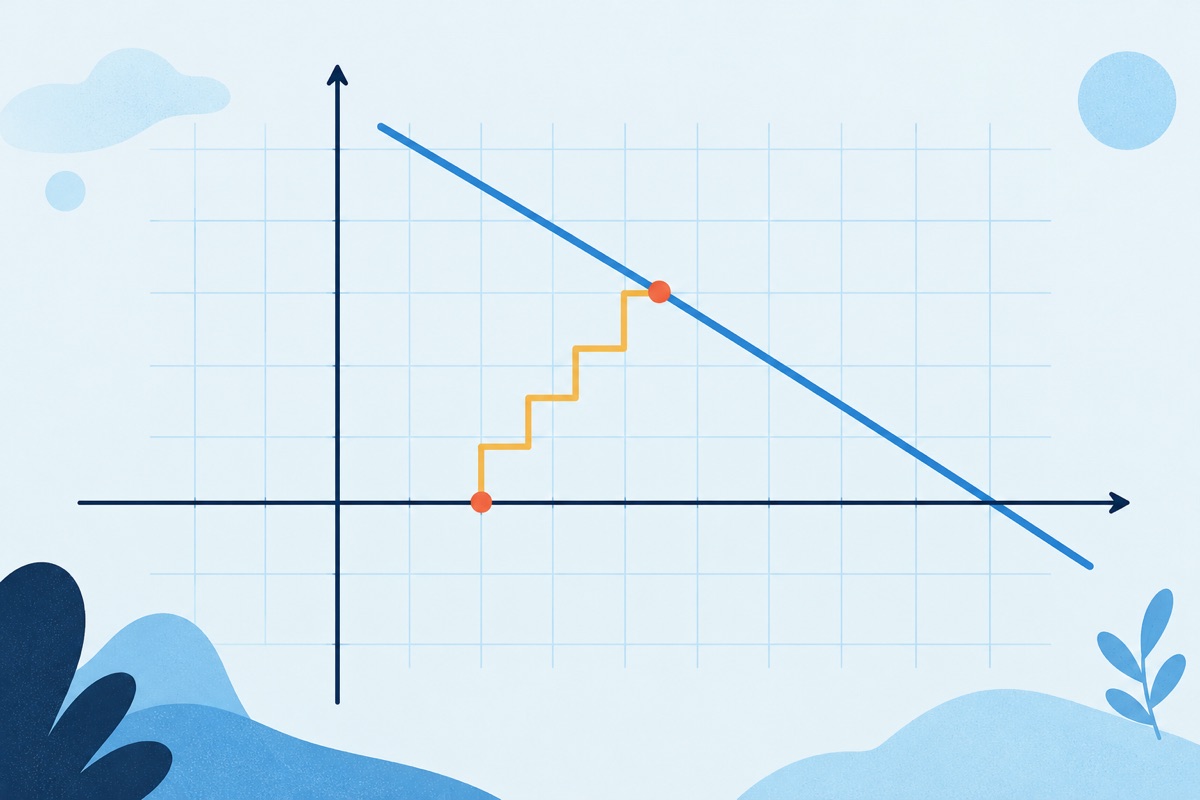
Walk the line instead of solving for it
Here is the move that makes most of these questions fast. A slope of 1/2 means "up 1, right 2." It ALSO means "down 1, left 2." So if you know one point on a line and you know its slope, you can walk along the line, step by step, until you hit an axis. No equation required.
Sometimes you don't even need the line
Data Sufficiency is the question type where you do not have to find the answer. You only have to decide whether the facts you are given are ENOUGH to find it. Coordinate geometry shows up here a lot, and it is where people burn the most time, because they try to build the whole equation when the question only cares about one small thing.
The mistakes I see over and over
- Working the whole thing in your head. Negative signs are where coordinate questions go to die. One dropped minus sign and you are picking a trap answer with total confidence. INSTEAD: write every point down, and write the subtraction out, like 4 − (−2), before you simplify it.
- Skipping the sketch because it feels "too basic." That is pride talking, and pride is a terrible test strategy. INSTEAD: a rough grid and two dots on every coordinate question, even the easy ones, so the habit is automatic when the hard ones show up.
- Subtracting in a different order on top and bottom. If you do y2 minus y1, you MUST do x2 minus x1, from the same point. INSTEAD: label your points "first" and "second" on paper and subtract the same way in both places.
- Building an equation the question never asked for. INSTEAD: ask yourself what the question actually wants (a slope, a sign, an intercept) and go straight at that one thing. Walk the line when you can.
- Mixing up the two intercepts. INSTEAD: remember x-intercept means y is 0, y-intercept means x is 0, and circle which one the question asks for before you do any math.
This is training, not cramming
You would not learn a tennis serve by reading about it once. You hit thousands of serves until the motion is boring. Coordinate geometry is the same. The goal is not to "get" it once. The goal is to make drawing, labeling and walking the line so automatic that the words "In the xy-plane" stop causing a jolt at all. That calm matters later in the test too, because the same steady pacing you build here is what lets you read Reading Comp at the perfect pace instead of rushing and re-reading.
And you have to decide what you want MORE: to feel clever by skipping the sketch, or to stop handing away the gettable points? Those gettable points add up across a section. Just like the probability problem hiding behind your Verbal score, a small error rate repeated over many questions turns into a real score gap.
Here is your challenge for today. Pull up 10 coordinate geometry questions you have already done, including ones you got right. Redo every one of them with a sketch, written points and the walk-the-line method. Time yourself. Then compare your new notes to your old ones. I'll bet that your old scratch paper has fewer marks on it than it should, and I'll bet that at least one of your old "right" answers took you twice as long as it needed to. Go find out.